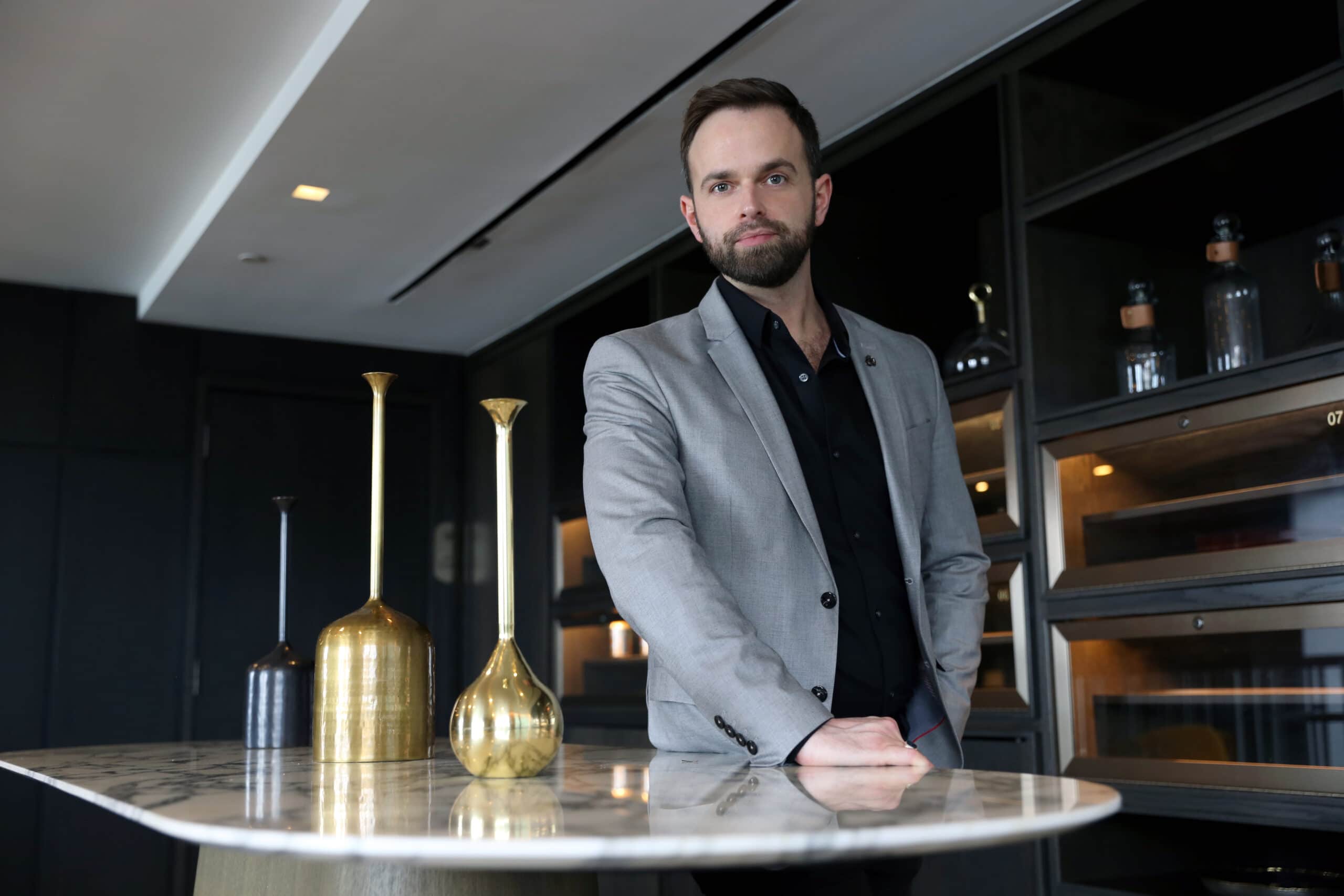
When asked to describe the bold and multifaceted personality of Will Sears, Founder & CEO of W.Bradford, a broad spectrum of words could apply with perfect precision—passionate, relentless, demanding, fiery, empathetic, tough or humorous would not be out of place. Those who have met and worked with Will have likely encountered these traits and many others, all of which Will says he has learned to channel to his benefit based on the scenario at hand.
The difference in how he channels his personality now, compared to his younger years, is greater intention to apply his traits with good intentions, rather than selfish motives—running a business has schooled him in the elusiveness of thinking a person can control what will happen on a given day, no matter how calculated or determined he or she may be.
Now, with his characteristic straightforwardness, Will shares his responses to questions in the agency’s new ‘On The Record’ interview series, covering a wide range of personal and professional topics. Join us in getting to know the young CEO driving the intense momentum behind our agency’s growth.
Pictured (above): Will Sears, Founder & CEO of W.Bradford
You walk into an elevator, and are asked what you do. How would you describe yourself?
WS: My answer depends on a variety of factors. First, how much time do I have? Sometimes, simply saying “I work in marketing” gets me in and out of the situation if I’m exhausted in a hurry, both of which are usually the case. Other times I will say I own a marketing agency, which of course leads to more questions about what kind of marketing, do I have employees, how long have I had the business, etc. Over the past couple of years, I have found it increasingly difficult to separate Will from W.Bradford when answering the question, however, since so much time and energy goes into the business versus into my other interests and needs. It’s a dynamic I’m trying to work on as time and headspace allow.
What behavior or personality trait do you attribute your success to, and why?
WS: As an overarching response, I must say I am only successful to the extent that I have had strong, smart people guiding and shaping me whether at home or in school, paired with the combination of strengths and weaknesses inherent to who I am as my own person. That said, there is a trait that has become my internal drumbeat as I’ve encountered the ups and downs of a pretty dynamic life for a 33-year-old guy, which is a trait of being willing to commit to do whatever it takes to achieve a goal. In the past I’ve set daunting goals such as becoming a valedictorian in high school, getting perfect grades in college, earning this or that promotion at places I’ve worked, or even losing 25 pounds.
Meeting those goals and others was not easy and required a focus on the broader requirements for achieving them, while also requiring me to train an awareness of which boxes need to be checked off on a daily basis to stay on track. Meeting such ambitious goals also took a relentless and almost always exhausting commitment that spanned a long period of time. Without the ability to muster the inner strength to rise to such commitments and not lose heart when others gave up, I would certainly not have many of the milestones I’ve enjoyed thus far in my life and career.
How would you describe W.Bradford? How has the agency matured since it first opened?
WS: I always say privately owned businesses that were started from scratch embody the personality, strengths and weaknesses of the person who founded them. That is certainly true for us. We are a combination of classy and sassy on the personality side; you’ll see black and gold and rich colors on all of our branding, but quick-witted and edgy quips along the way. On the strengths side, we are tough and fight individually and as a team when times are tough, and we laugh and celebrate with gratitude when times are good. On the weaknesses side, we are always working to be more collaborative rather than thinking we have to take on the world individually, which is something I have always struggled with.
W.Bradford is like other new businesses in the usual ways, though, in that we know we are only as good as the work we do each day as we build our own reputation and record of success. That takes time and patience, and far more humility than I had before starting the business. Building a business and a reputation doesn’t require that you always succeed and do things perfectly on the first try, but that you remain committed to doing exceptional work and meeting client expectations at whatever cost.
What do you wish you knew before you started your first business?
WS: What a loaded question! I actually agree with a response to a similar question I asked Rebecca Weir, a lighting designer, whom I interviewed during a video shoot in London last year. She said that a company is like a child, because with each stage of growth is a whole new labyrinth of new and unique challenges. That is a truth that cannot be overstated. I also agree with her additional wisdom, which I cannot articulate better myself: “I have learned to respect differences, to not trust everyone, that people are not necessarily kind or generous, respect must always be earned, and not to worry about what others think,” she said. “Create your own path, don’t look to follow or bother looking over your shoulder, and don’t worry if others copy you.”
Do you believe there is some sort of pattern or formula to becoming a successful CEO?
WS: The relationships I have formed and nurtured over the years are the reason I was able to start a business, and continue to be the driving force behind why we continue to grow as a business. Oprah once said in an interview that she knew she would always do well in her career, because she treated others well and treated herself well. I agree with that. It would be easy to be cutthroat and manipulative to get ahead in business in the short term, and I have taken that approach in past positions I’ve held when I was younger and more immature in my career. But running a business will shut that approach down quickly, because we really have succeeded or failed based on how well we manage and nurture relationships with clients. We do operate around a principle of good karma at W.Bradford, and we have seen many a challenge fall to the wayside when we’ve stuck to our guns and didn’t give up on doing the right thing.
What has been your most satisfying moment in your career?
WS: Most people will think of the show-horse side of my personality in anticipation of how I would answer this question, but I have to say my proudest moments are when I am at my desk at 5 a.m. to complete something critically important for a client or the business. We as humans all fear we might fail, or maybe we will be the ones with the businesses that won’t make it another year, or that we won’t be smart or capable enough to figure out the daunting challenge of the moment—and the list goes on. So there’s something satisfying and invigorating about pausing during those times when you are in the trenches, many times standing alone, and thanking God and yourself that you still believe in what you’re doing enough to keep grinding forward.
Who has influenced you most when it comes to how you approach business?
WS: My dad, who I am very much like inside and out, was a coal miner for over 30 years and continued in that industry for at least a decade more. To this day, he is the only person I know who can out-work me, and he always seems to find his way to smart, logical, efficient outcomes. So in business when I’m making important decisions, I often hear my dad’s voice. Some of his one-liners are on the tip of my tongue so often that employees have picked them up along the way, such as, “Don’t let people jerk you around,” and, “It doesn’t rain every day.” I can imagine my dad overseeing a large crew of coal miners, when he took on his biggest challenge in his career to mine a tunnel through the base of an entire mountain—miles long—and making sure he was on the clock when they broke through to the other side so he could see his goal become a reality. That goal took years of brutal physical labor, challenges with employees and equipment, unexpected setbacks, and calculated risks that could mean life or death. A man who can make something like that happen from beginning to end is someone whose wisdom and business acumen should not be ignored.
What’s the biggest misconception people have about being a CEO?
WS: People think a CEO sets his or her own schedule and works for himself/herself. These are absolutely not true. The majority of working people are familiar with a 9 a.m.-5 p.m. workday and a bank of vacation days to take whenever they’d like. That sounds pretty nice, but is far from my current reality. My schedule, especially in the last couple of years, has skewed more closely to the opposite of normal—from 5 a.m.-9 p.m. I also believe clients and my employees are my bosses, because I answer to all of them. That is far different from having one supervisor in all of my other jobs. Perhaps one day I can kick up my feet on a yacht and get a fat check in the mail without having to lift a finger, but so far that hasn’t been how this whole “CEO” thing has worked [laughs].
As more and more brands are bringing aspects of their creative services in-house, how can brands continue to leverage agencies most effectively?
WS: Over the past several years, the industry has seen a trend toward project-based client engagements and away from recurring retainers. I think that stems from more sophisticated clients, who are able to form their own team of agencies to execute their respective areas of expertise most effectively. This is smart, and is actually the way we are evolving as an agency in terms of how we staff projects. There is a more concerning trend, however, toward brands relying entirely upon customer data that can be crunched in-house by an accountant versus understanding the value of investment in thoughtful, inspiring creative work. I believe people know when companies are manipulating their data to shape their actions—take Facebook as a prime example—rather than inspiring them with stories, art or other creative outputs that can still achieve the desired outcome. Brands should use data to inform strategies and measure outcomes, not to force them.
What’s the best advice you were ever given? Who was it from?
WS: I can’t pick one piece of advice or one person, but one piece of advice coming to mind worth sharing is from my grandfather, who would always tell us as we would leave his house after a visit, to “hold it in the middle of the road” on our way home. What a simple and funny thing to say, but I think the meaning is that we can always get to a desired end if we keep aiming at the right direction without veering off the path one way or another.
What was your first job? Has it influenced your work ethic today?
WS: My first job after college was as a communications director for an environmental non-profit, where I was the only employee other than the owners and had a wide range of tasks—from pitching media about their latest books or speaking engagements, to booking their travel and stuffing envelopes. We all worked from home, which took some discipline for me as someone who had just graduated college, and the volume of work we all produced continues to baffle me. During that time, my bosses trusted me to find new ways to communicate their story, take risks to expand their audience, and challenge fundamental ways they approached advancing their business despite my age and lack of experience. In response to the opportunities and trust they extended to me, I worked my guts out for them. So perhaps more than shaping my work ethic which has always been part of who I am, they shaped how I would someday try to manage other people: Trust, empower, listen and risk giving people chances to exceed your expectations (and theirs).
If you were to tell one person “Thank You” for helping you become the person you are today, who would it be, and what did they do?
WS: I would thank my mother—and I can’t say I can thank her for who I am today, because she is a far better person than I am, but I do thank her for who I hope I can someday become. For as long as I can remember and photos can prove, my mom has demonstrated a commitment to her taking care of her family. When I was a really young child, my sister and I watched her go back to college to become a teacher. At that age, we saw what it was like to commit to something, as I can remember her sometimes taking the two of us to her classes when no one was around to keep us during the day. As we grew up, she was always the one coming through for my sister and me, whether we needed encouragement when we were having trouble making friends or struggling through a difficult class, and even when I signed her up to cook a whole turkey for my first-grade Thanksgiving feast. Then I saw her travel hundreds if not thousands of miles with my grandmother to help her battle lung cancer, effectively adding years to her life that would otherwise not have transpired. And now I watch my mom’s passion for her grandchildren (my niece and nephew), and her desire for me to do well and be happy, and I realize that her heart and mind will never rest as long as there is one more thing she can do for her family. What a noble and worthwhile way to process and approach life; I have a lot of work to do!
Who are five people you would you most like to have dinner with, living or dead?
WS: We’ve all answered this question over the years, but at this stage in my life I find I don’t need any famous or powerful people at my table, but the people who allow me to be myself—or who challenge me to be a better version of myself. That would include my mom and dad, my sister Jennifer, my “Mamaw and Papaw” on my dad’s side, my grandmother “Mama Rose” on my mom’s side whom I idolized (and still do), my sister, my niece and nephew, and of course my two extraordinary dogs Dora and Cooper who are the ying and yang embodiments of the person I am proud to be today.
And I know I named more than five people but, hey, I own the place…